Indoor Puppy Games for Rainy Days
Rainy days can turn a puppy into a small, furry weather emergency.
Start by clearing one safe play area. Move slippery rugs, cords, shoes, and breakable objects out of reach. Then choose one simple game and keep the first round short.
Good indoor puppy games use the nose, brain, and body. They also teach useful skills without turning your living room into an obstacle course disaster.
Match the Game to Your Puppy
Puppies differ in age, size, confidence, and energy. A bold older puppy may enjoy searching several rooms. A younger or cautious puppy might prefer one easy hiding place nearby.
Watch how your puppy responds during play. A comfortable puppy stays interested and can still pause or listen. A worried puppy may freeze, avoid the game, hide, or refuse food.
Excitement can also tip into overload. Wild biting, frantic running, barking, or ignoring familiar cues may mean your puppy needs a break.
End the game while it’s still going well. A short success is more useful than a long, chaotic session.
Begin With a Sniffing Game
Sniffing gives puppies a job without requiring much space. It’s often a handy choice when outdoor exercise is limited.
For an easy “find it” game, let your puppy watch you place food nearby. Say “find it,” then encourage them to sniff it out.
Once that feels easy, hide food behind a chair leg or beside a box. Keep every hiding place accessible and safe.
Use part of your puppy’s normal food when possible. This helps prevent games from becoming a steady stream of extra snacks.
Don’t hide food near household cleaners, medications, cords, or unsafe plants. Avoid tight spaces where a puppy’s head could become trapped.
You can also scatter a few pieces of food on a clean towel. Spread them apart and let your puppy search with their nose.
Supervise closely if your puppy chews or swallows fabric. In that case, place the food directly on a clear floor instead.
Play the Cup Search Game
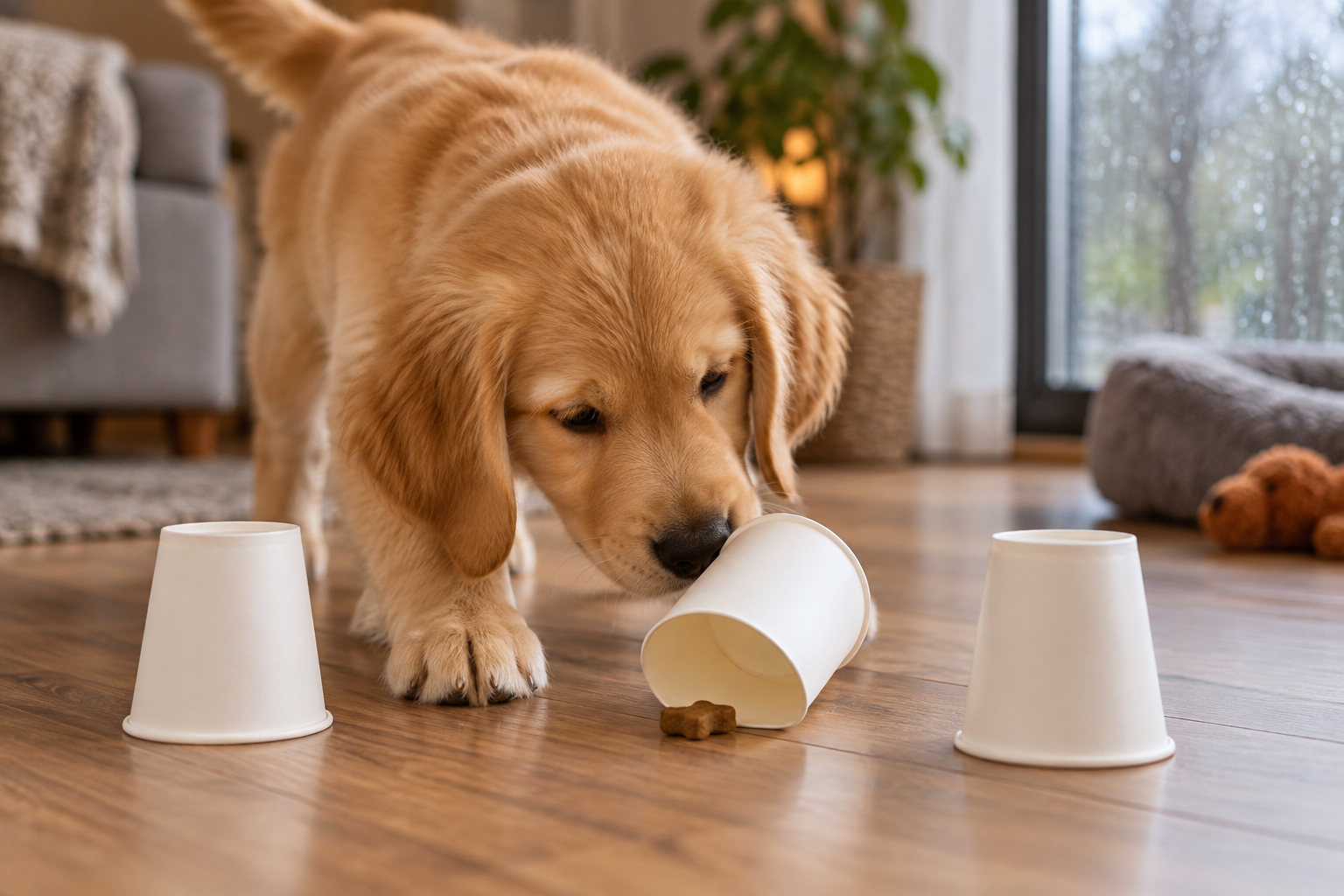
Place a piece of food under one lightweight, puppy-safe cup. Let your puppy sniff, nudge, or paw at it.
At first, lift the cup as soon as your puppy shows interest. This teaches the basic idea without causing frustration.
Later, add a second empty cup. Keep the setup easy enough that your puppy continues trying calmly.
Choose cups that won’t crack into sharp pieces. The opening should also be too small for your puppy’s head to enter.
Put the cups away after the game. They aren’t chew toys, even if your puppy files a passionate appeal.
Turn Training Into Play
Training can be one of the easiest indoor puppy games. It uses little room and builds skills you’ll need every day.
Pick one simple cue, such as:
- Sit
- Touch
- Come
- Drop it
- Go to bed
- Look at me
Keep each practice round brief. Stop before your puppy loses interest or becomes frustrated.
For “touch,” hold an open palm near your puppy’s nose. Mark the moment their nose meets your hand with a cheerful “yes,” then reward them.
Once your puppy understands, move your hand slightly to either side. This becomes a gentle movement game and a useful way to guide them.
For indoor recall practice, move a short distance away. Say your puppy’s name and your chosen recall word once.
Reward them when they reach you. Don’t use recall to call your puppy toward something unpleasant whenever you can avoid it.
Several family members can take turns calling the puppy between them. Keep distances short and the floor free from slipping hazards.
Try Hide-and-Seek Together
Ask someone to hold your puppy while you hide nearby. Call once, then let your puppy search for you.
Start with obvious places, such as beside a doorway. Celebrate when your puppy finds you, but avoid loud reactions that might startle them.
As your puppy improves, hide farther away. Never hide somewhere that encourages climbing, jumping, or squeezing behind furniture.
Playing alone? Ask your puppy to stay only if they already know that cue. Otherwise, toss a piece of food away from you, then step behind a nearby door.
Hide-and-seek practices recall and encourages puppies to use their senses. It also makes you part of the fun, which is always a nice career move.
Make a Safe Cardboard Search Box
A shallow cardboard box can become a simple search game. Place several loosely crumpled sheets of plain paper inside, then sprinkle food among them.
Let your puppy sniff and move the paper. Keep the box open and easy to leave.
Supervise the whole game. Remove the box if your puppy starts eating cardboard, tape, labels, or paper.
Don’t include plastic packaging, staples, string, or small objects. Shredding isn’t safe if your puppy swallows the pieces.
Some puppies find rustling paper exciting. Others think it’s suspicious wizardry. Introduce the box gently and never push your puppy toward it.
Build a Low, Gentle Obstacle Course
An indoor course should focus on careful movement, not athletic stunts. Use objects your puppy can walk around, between, or over safely.
You might create a route with:
- Chairs to weave around
- A wide cardboard box to walk through
- A broom laid flat to step over
- A blanket as a different walking surface
- A mat that marks the finish
Guide your puppy slowly with food or your hand-target cue. Reward calm movement instead of speed.
Keep everything at floor level. Repeated jumping, sharp turns, and slippery surfaces can strain a growing puppy’s body.
Don’t ask your puppy to leap from furniture or race on stairs. Young puppies are still learning coordination, and their joints are developing.
Avoid unstable tunnels or chairs that could tip. If the course shifts, collapses, or frightens your puppy, stop and simplify it.
Play Tug With Clear Rules
Tug can be a lively indoor game when it stays controlled. Choose a dog toy long enough to keep teeth away from hands.
Move the toy side to side near floor level. Avoid lifting your puppy, twisting their neck, or jerking the toy sharply.
Pause now and then. Ask for “drop it” only if you’ve already started teaching that skill.
You can trade the toy for food, then offer it again. Giving the toy back helps your puppy learn that releasing it doesn’t end all fun.
Stop if teeth touch skin or clothing. Pause calmly, then restart with the toy when your puppy has settled.
Children need close adult supervision during tug. A bouncing puppy can accidentally grab small hands or knock someone over.
Roll Toys Instead of Throwing Them High
A hallway can work for gentle retrieving if the floor provides good grip. Roll a toy along the ground rather than throwing it into the air.
Rolling reduces jumping and awkward landings. It also makes the toy easier for a young puppy to follow.
Use a soft toy that’s too large to swallow. Check it for loose parts before and after play.
Don’t chase your puppy to get the toy back. That often creates a much more exciting game called “you can’t catch me.”
Instead, trade for another toy or a piece of normal food. You can also move away and encourage your puppy to follow you.
Rotate Toys for Fresh Interest
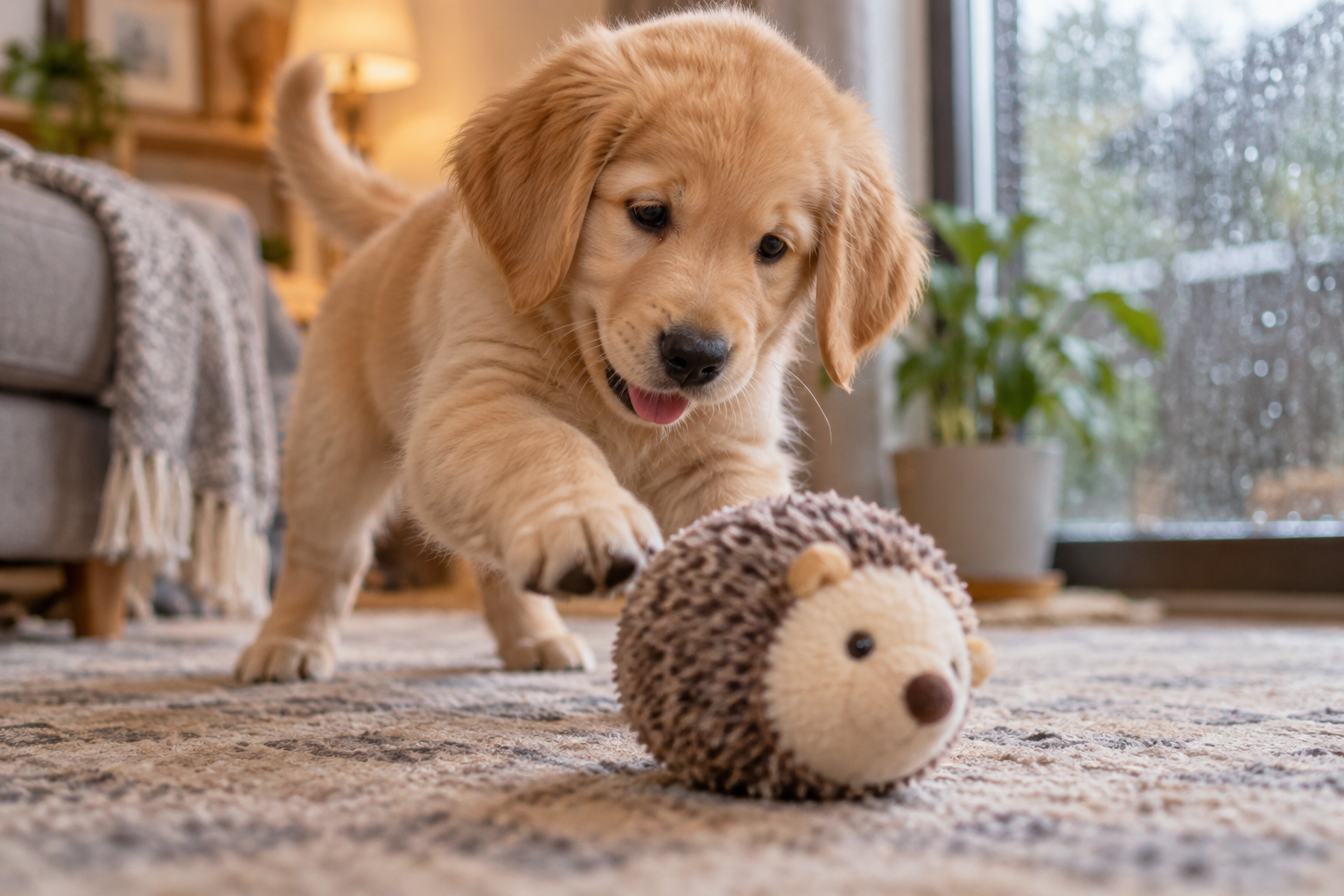
Your puppy doesn’t need every toy available at once. Put some away, then bring out a different selection later.
Rotation can make familiar toys feel interesting again. It also gives you time to inspect them for damage.
Offer toys with different safe textures and uses. A puppy might have one for carrying, one for tugging, and one for supervised food play.
Choose items that suit your puppy’s size and chewing style. A toy that works for one puppy may break too easily for another.
Remove anything with torn seams, exposed filling, sharp edges, or missing pieces. If part of a toy may have been swallowed, contact a veterinarian promptly.
Use Food Toys With Care
Food-dispensing toys can keep a puppy busy through licking, nudging, or rolling. Begin with an easy setup so the reward comes out readily.
A difficult puzzle may cause barking, chewing, or frustration. Make it simpler if your puppy can’t succeed after a reasonable attempt.
Count food used in games as part of the day’s normal amount. Ask your veterinarian what food is suitable if your puppy has allergies, stomach problems, or medical needs.
Avoid improvised containers with narrow holes or sharp cut edges. Puppies can trap their jaws or damage teeth while trying to reach food.
Always supervise the first few uses of any food toy. Check the product guidance for sizing, cleaning, and safe use.
Practice Calm Games Too
Rainy-day enrichment doesn’t need constant action. Learning to settle is a valuable puppy skill.
Place a mat or bed near you. Reward your puppy for stepping onto it, sitting, or lying down.
Deliver rewards low and calmly. You’re building a quiet association, not launching another party.
A safe chew may help some puppies relax. Choose one appropriate for your puppy and supervise its use.
Chews shouldn’t be hard enough to risk damaged teeth or small enough to swallow. Ask a veterinarian for guidance if you’re unsure what suits your puppy.
You can also sit nearby and gently handle a paw, ear, or collar. Reward relaxed behavior and stop if your puppy pulls away or looks uncomfortable.
This gentle practice can make future grooming and handling less surprising. It shouldn’t involve restraint or forcing contact.
Create a Simple Rainy-Day Routine
Indoor play works best when balanced with toilet breaks, meals, rest, and calm time. Puppies often need more sleep than their behavior suggests.
A simple routine might look like this:
- Take a short toilet break when conditions are safe.
- Play one sniffing or search game.
- Practice one training skill.
- Offer calm time on a bed or mat.
- Let your puppy sleep without interruption.
You can repeat the pattern later with a different game. There’s no need to fill every waking minute with entertainment.
If outdoor conditions are merely wet, your puppy may still benefit from a brief walk or sniff outside. Use suitable gear and dry them afterward.
Skip outdoor exercise during unsafe weather, such as lightning, flooding, dangerous winds, or extreme temperatures. Indoor games can fill the gap until conditions improve.
Know When Play Should Stop
Stop immediately if your puppy is limping, crying, breathing unusually, or moving with difficulty. Sudden weakness, collapse, repeated vomiting, or possible swallowing of an object also needs prompt veterinary help.
Less urgent signs still matter. A puppy who suddenly avoids normal play, seems unusually tired, or has a major behavior change should be checked by a veterinarian.
During ordinary play, take a break when your puppy becomes frantic or stops responding. Offer water, a toilet trip, and a quiet resting place.
Don’t assume every burst of biting means more exercise is needed. An overtired puppy can look remarkably energetic while desperately needing sleep.
Pick One Game for Today
Choose the easiest idea that fits your space and puppy. A one-room “find it” game is a great place to begin.
Clear the floor, set aside some normal food, and hide one piece in plain sight. Your rainy-day plan is officially underway—no tiny raincoat required.


