Getting Your Puppy Used to a Harness and Leash
A harness can make a puppy suddenly forget how legs work. One moment they’re bouncing; the next, they’re a furry statue.
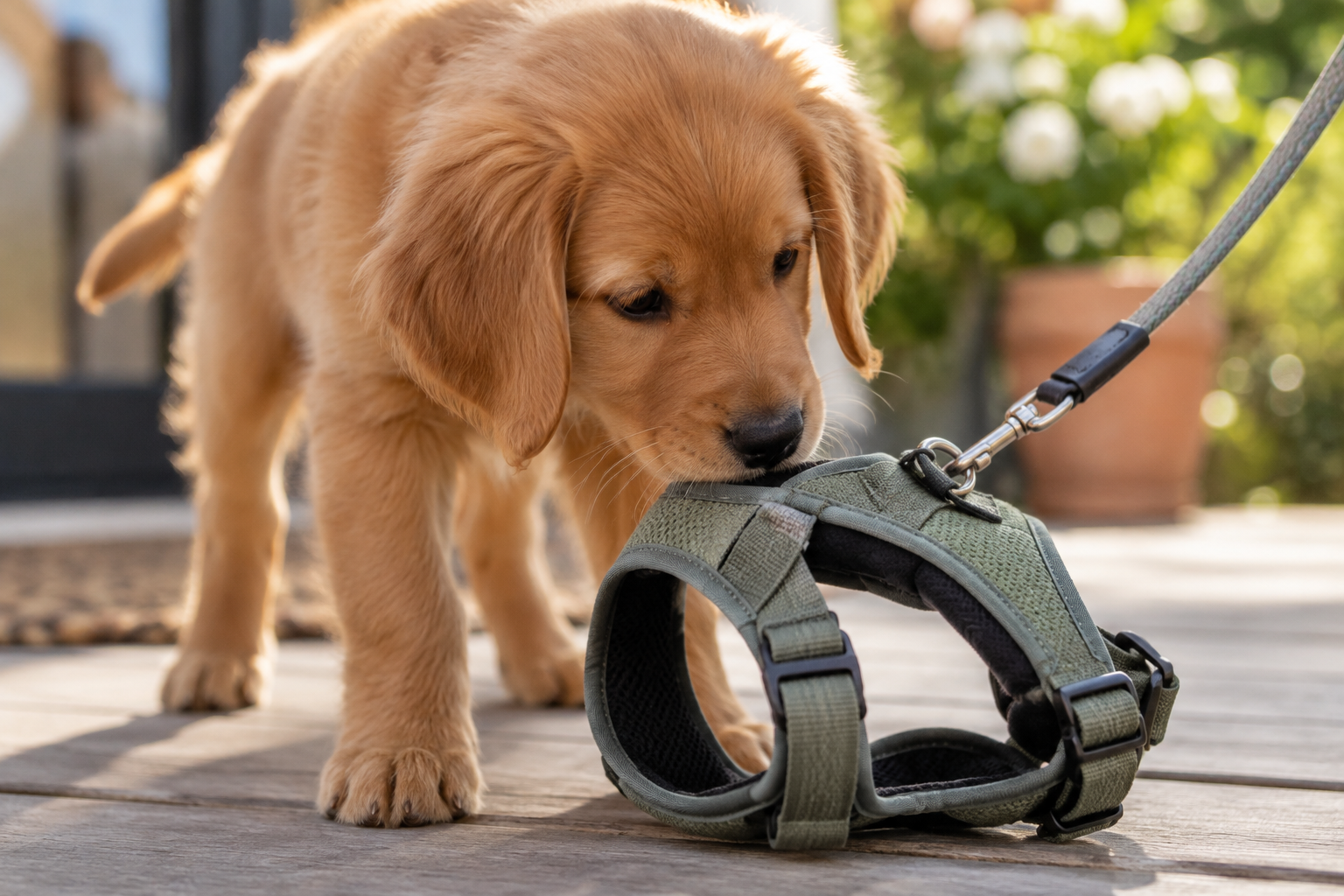
Start by placing the harness on the floor. Let your puppy sniff it without trying to put it on yet.
Choose a comfortable harness
A harness should fit snugly without pinching or rubbing. Your puppy shouldn’t be able to back out of it.
Check the maker’s fitting instructions for your chosen design. In general, you should be able to slide a couple of fingers beneath the straps.
Watch where the straps sit when your puppy moves. They shouldn’t press against the throat or restrict the shoulders.
Puppies grow quickly, so check the fit often. A harness that fitted last week may become tight surprisingly fast.
Simple designs are usually easier for beginners. Some go over the head, while others open around the neck and body.
If your puppy dislikes things passing over their head, choose a harness that opens more fully. Comfort matters more than having the fanciest buckle collection.
Let your puppy investigate
Before putting the harness on, make it part of a pleasant moment. Place it nearby while offering small pieces of your puppy’s usual food.
This method is called positive reinforcement. It means something good follows the behavior you want to encourage.
Reward your puppy for looking at the harness. Then reward sniffing or moving toward it.
Don’t push the harness into their face. Let curiosity do some of the work.
If your puppy grabs it like a toy, calmly trade it for an appropriate chew. Put the harness away after practice so it stays safe and intact.
Introduce the harness in small steps
To introduce puppy to harness and leash successfully, split the process into tiny lessons. Aim for calm progress rather than getting everything done at once.
First, touch the harness gently against your puppy’s shoulder. Reward them, then move it away.
Next, practice the motion needed to put it on. For an over-the-head harness, reward your puppy for placing their nose near the opening.
You can hold a treat on the other side of the opening. Let your puppy choose to move their head through.
Avoid pulling the harness over a reluctant puppy. Forcing it can make the next session harder.
Once your puppy seems comfortable, fasten one buckle. Reward them and remove the harness after a few seconds.
Gradually leave it on for longer periods. Keep your puppy busy with food, a toy, or a simple training game.
Help your puppy move normally
Some puppies scratch at a new harness or walk as if gravity has doubled. A little uncertainty is normal at first.
Encourage a few steps by moving away cheerfully. Reward your puppy when they follow.
Keep these first sessions indoors and brief. Stop before your puppy becomes tired, frustrated, or desperate to escape.
Don’t leave a harness on an unsupervised puppy. Straps can catch on furniture, crates, or other objects.
Check your puppy’s skin after practice. Remove the harness if you notice rubbing, pinched fur, or sore areas.
Freezing, hiding, repeated escape attempts, or frantic biting mean the lesson is too difficult. Remove the harness calmly and return to an easier step later.
Add the leash indoors
Attach a lightweight leash once your puppy can move comfortably in the harness. Keep hold of it rather than letting it trail around unattended.
Let the leash stay loose at first. Follow your puppy for a few steps so they can get used to the feeling.
Then encourage them to follow you. Take one or two steps, reward them, and pause.
Practice turning gently in different directions. Your puppy can learn that watching you makes walks easier and more rewarding.
Never jerk the leash or drag a frozen puppy. Pressure often causes dogs to pull backward, which can frighten them or help them slip free.
If the leash becomes tight, stop moving. Encourage your puppy back toward you, then continue when the leash loosens.
Handle leash biting calmly
A swinging leash looks like an excellent toy to many puppies. It wiggles, follows them, and apparently has no manners.
Keep the leash as still as possible when your puppy grabs it. Tugging back can turn biting into an exciting game.
Offer a toy or ask for a familiar behavior, such as a sit. Reward your puppy when they release the leash and focus on you.
Puppies often bite more when they’re overstimulated or tired. If leash grabbing keeps returning, end the session and allow a quiet break.
Don’t use the leash to play tug. It needs to remain reliable safety equipment.
Take practice outside gradually
Begin in a quiet, secure area when outdoor activity is appropriate for your puppy. Ask your veterinary professional about local disease risks if you’re unsure where your puppy can safely walk.
The outdoors adds smells, sounds, people, dogs, and fascinating leaves. Lower your expectations while your puppy processes all that information.
Start near your door or in another calm spot. Reward attention, loose-leash steps, and checking in with you.
A “check-in” simply means your puppy looks toward you voluntarily. Praise or reward that choice before they become distracted again.
Keep early outings short. Sniffing and calmly observing the world are useful parts of a walk, not wasted time.
Give other dogs and people enough space. Your puppy doesn’t need to greet everyone they see.
If your puppy crouches, trembles, tries to flee, or refuses food they normally enjoy, move somewhere quieter. Persistent fear or a sudden change in behavior deserves help from a qualified trainer or veterinary professional.
Build better walks, one step at a time
Harness and leash skills develop through repetition. Some puppies adjust in a day, while others need many gentle sessions.
Practice in easier places before adding busy paths. A quiet hallway is simpler than a sidewalk full of squirrels, scooters, and social opportunities.
Use small rewards so your puppy doesn’t fill up quickly. You can take suitable pieces from their normal food allowance.
Praise, sniffing breaks, and forward movement can also be rewards. Notice what your puppy values in that moment.
Finish while things are going well. A successful two-minute lesson is more useful than a long struggle.
Today, place the harness on the floor and reward one calm sniff. That tiny step is the beginning of many comfortable walks together.