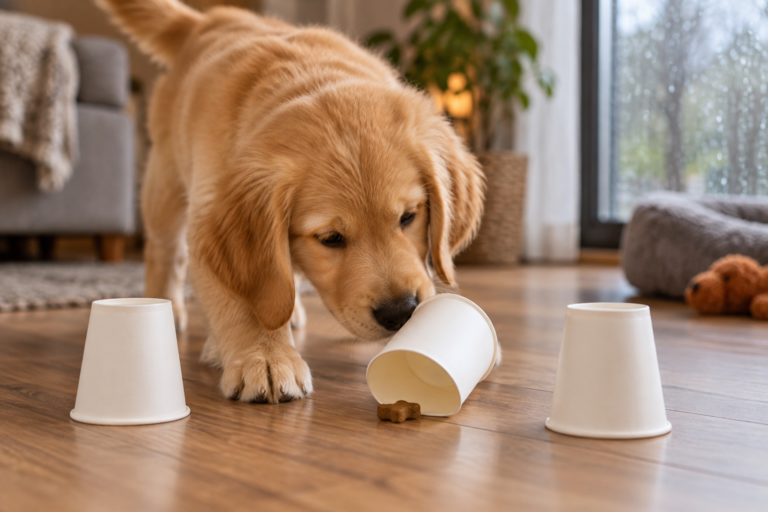
Easy Sniffing Games for a Puppy With a Very Busy Nose
A puppy’s nose is basically a tiny detective with no days off.
For an easy first game, place a few pieces of puppy food nearby. Let your pup watch, then say “find it” and encourage them to sniff.
That’s the whole beginning. No special equipment or advanced training required.
Why sniffing games are worth trying
Sniffing helps puppies explore and make sense of their surroundings. A scent game gives that busy nose a useful job.
These games can also add interest to ordinary days. They work well during rainy weather, quiet indoor time, or short training breaks.
Sniffing isn’t a replacement for walks, play, sleep, or social time. Think of it as one useful part of your puppy’s day.
Keep early games short and simple. Stopping while your puppy still feels successful can make the next round more appealing.
Start with a simple food scatter
A food scatter is one of the easiest sniffing games for puppies. It teaches your puppy to search without making the challenge frustrating.
Choose a clear, safe area with good footing. Scatter several pieces of your puppy’s usual food where they’re easy to find.
At first, spread the pieces across a small section of floor. Avoid placing food near stairs, electrical cords, or furniture your puppy might climb.
You can also scatter food across clean grass. Check the area first for rubbish, sharp objects, mushrooms, animal waste, and garden chemicals.
Use some food from your puppy’s normal meal when practical. This helps prevent enrichment treats from quietly becoming an extra meal.
If your puppy guards food around other pets, run the game separately. Each animal should have space to search without competition.
Play “find it” with visible hiding places
Once your puppy understands the basic search, make it slightly harder. Place food where it’s partly visible instead of fully out in the open.
Good beginner hiding places include:
- Beside a table leg
- Near the edge of a puppy bed
- Behind an open door
- Under the edge of an empty box
- Next to a safe, sturdy toy
Let your puppy see you place the first few pieces. Say “find it,” then give them time to work.
Try not to point out every piece immediately. A little patient sniffing is the activity, not a delay before it.
If your puppy wanders away, the game may be too difficult. Make the next hiding place obvious and celebrate calmly when they find it.
Make a towel search
Lay a clean towel flat and sprinkle food across it. Fold one edge loosely over a few pieces, leaving easy gaps.
Your puppy can nudge the towel and follow the scent. As they improve, you can add another loose fold.
Don’t tie the towel into a tight knot. A frustrated puppy may bite, pull, or swallow fabric instead of searching.
Supervise the whole game and remove the towel afterward. Skip this activity if your puppy tends to shred or eat cloth.
A bath mat can work in a similar way if it stays flat. Avoid mats with loose loops, damaged backing, or pieces that could come off.
Build a safe cardboard box search
Empty cardboard boxes can become a simple scent playground. Choose clean boxes without staples, tape, string, or packing material.
Begin with one open box placed securely on the floor. Drop food inside and let your puppy investigate.
Later, place several open boxes together. Put food in only some of them, so your puppy must check each scent.
Keep the boxes low and stable. Puppies shouldn’t need to climb, jump, or push through a wobbly pile.
Some puppies search neatly. Others immediately announce themselves as professional cardboard recyclers.
If your puppy tears off and swallows pieces, end the game. Switch to food scattered around solid, puppy-safe objects instead.
Create a tiny scent trail
A scent trail helps your puppy follow a path with their nose. Start in one quiet room with few distractions.
Place several pieces of food in a short line. Leave enough space between them for your puppy to sniff forward.
Put a slightly bigger reward at the end, such as a small handful of their regular food. Keep the ending easy to discover.
As your puppy learns, curve the trail around furniture or through a doorway. Check that the route has safe footing and no trapped spaces.
Avoid rubbing oily or sticky food across the floor. Small food pieces make less mess and are easier to remove afterward.
Hide yourself for a gentle search game
A familiar person can be the “prize” in a simple hide-and-seek game. Have someone hold your puppy while you step behind an open door.
Call your puppy once in a cheerful voice. When they find you, offer calm praise, play, or a small piece of food.
Begin with very easy hiding places. Your puppy should succeed through scent and sound, not become worried by your disappearance.
Never shut a young puppy alone in an unfamiliar room for this game. Keep it light, brief, and within their comfort level.
Let walks include real sniffing time
Not every sniffing game needs a setup. A slow walk can offer dozens of interesting smells.
When the area is safe, pause and let your puppy investigate. You don’t need to hurry them past every tree, fence post, or suspicious leaf.
Keep them away from unknown food, animal waste, traffic, and unsafe plants. Use a suitable lead and follow local rules outdoors.
A sniff-focused outing can be short and unhurried. Puppies vary in confidence, energy, mobility, and vaccination status, so ask your veterinary professional where it’s safe for your puppy to explore.
Make the game easier before making it harder
Increase only one challenge at a time. You might add more distance, use a new room, or hide food more carefully.
Don’t change all three at once. A puzzled puppy isn’t being stubborn; they may simply need a clearer clue.
Watch your puppy’s body language during play. Comfortable searching often looks loose, curious, and willing.
Pause if your puppy starts frantic scratching, repeated barking, hard biting, or rushing without sniffing. Offer water, a toilet break, rest, or a simpler activity.
Sudden reluctance to sniff, trouble breathing, nasal discharge, repeated sneezing, or a major behavior change needs qualified veterinary advice. Don’t continue a scent game if your puppy seems unwell or distressed.
Keep the rules simple
Use a consistent phrase such as “find it” when the search begins. Choose another phrase, like “all done,” when you remove the game.
Supervise activities involving food, fabric, boxes, or small objects. Pick up leftovers before another pet or curious puppy finds them later.
Most importantly, let your puppy solve manageable problems. Sniffing games should feel interesting, not like an entrance exam for detective school.
Today, try scattering five pieces of regular puppy food across one safe room. Say “find it,” step back, and let that very busy nose begin.